Darktable For Mac
Photographers considering using a computer based on Linux not seldom have exactly one reason to do so: Darktable. Darktable is an open source project, best compared to Adobe Lightroom. It is a photo editor following the workflow of photographers, thus having them easily feel familiar with the app. Beginners will be overwhelmed by its feature richness. Now there is another option, if you don’t want to use a Linux-system.
A few days ago, Darktable has been made available for Mac OS X Darktable: Lighttable, darkroom, tethering It almost sounds too good to be true. But the project doesn’t need to hide behind the functionality of its commercial competitor Lightroom. Some even say, that Darktable’s RAW Tools are even better than those Adobe has to offer. Adobe recently changed the name of its product to Photoshop Lightroom and dropped the price for the most recent version 4 to an affordable 149 USD. As the competitors show similarities in the look of the whole user interface, I wonder who got inspired by whom.
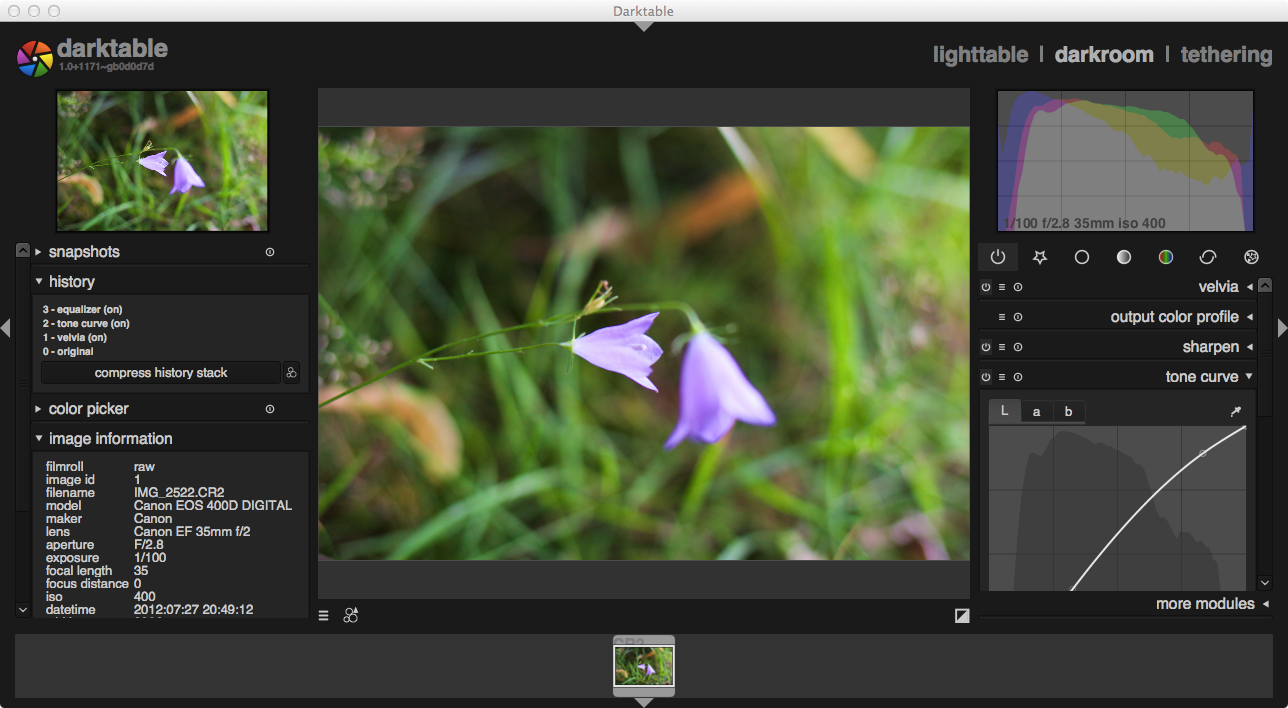
Darktable’s lightroom in standard view Darktable, available in several languages, that are automatically invoked, according to the operating system it detects, follows a modularized workflow. Lighttable lets you do administrative tasks in the likes of Bridge or Picasa or Lightroom. Meta-data can be viewed and changed. Categorization can be done from here, as well as sorting operations in a variety of ways. The module darkroom is responsible for the manipulative work. As darktable is limited to tasks that real photographers would do in real darkrooms, we don’t have the opportunity to work on collages or other montages. All effects, corrections and related functionality can only be invoked on photographs.
Darktable’s methods are powerful and very finely tunable. The results are often described to be better than what can be achieved using so-called professional software such as Lightroom. The last module, called tethering, is used to connect cameras to Darktable in a way that their contents can be imported automatically. Darktable’s darkroom with an image opened The product is comfortable and fast, the results are high-class. Moreover, Darktable is completely free. If you’re into one of the many Linux-derivatives, you probably know that for quite a long time to the users of the open source OS. Ubuntu-users will even find a version of Darktable pre-installed.
Be aware that these usually are older versions, so make sure you update soon as possible, using one of the many repositories available. If your OS carries names such as Fedora, Suse or Gentoo, the same applies to you. Fit as a fiddle programmers of course just compile their own version using the – or Github-sources, just like Chuck Norris would do. Wait, probably with Chuck Norris sources compile themselves to avoid having Norris compile them. Anyway Freshest member of the family is, which is available.
If you read the blog entry that announces the availability of the Mac-version, you’ll feel flooded with comments of users stating to have a wide variety of problems using, configuring, but also even installing the app. Darktable for Mac OS X: a little self-test Gotten insecure from the comments I mentioned before, I decided to give Darktable a spin, so none of our readers would run into trouble and probably blame me for having gotten their MacBooks damaged. I installed Darktable as is usually done using the downloaded DMG.
Darktable went from a lean 15,5 MB DMG to a not so much fatter 52 MB app. And I did not experience any problem whatsoever.
I imported over 1.000 pictures into lighttable and I was able to fire effects and filters at chosen pictures without any misbehaviour on the side of Darktable. Everything worked absolutely flawlessly, until I tried to connect my camera via the tethering-module.
I couldn’t get that to work, but a workaround for this problem is already in existence. As I never use automatic importing of pictures, I didn’t give this workaround a spin, though. The recent version of Darktable carries the number 1.05. The whole project is organized professionally und comes with a documentation, that leaves no stone unturned. You should definitely check out.
People seeking a solution to professionally manipulate their photos, need not push out cash any longer. As cash always tends to vanish as soon as you look at it, Darktable might save you from premature bankruptcy and help you lead a happier life. You should have a 64-bit OS, though.
It still runs on 32, but you know. I’ve been using darktable on a not-that-old machine for a year now, but 2 Gio is not nearly quite enough. I can manage to work as it is, but when it comes to exporting pictures, I can but shut the GUI and use a bash to work out my shots with darktable-cli. Apart from this point, darktable is truly a great tool, even if I miss some features or at least some quality features -vintage effects for example: I never succeeded in making the splittoning effect produce what I want- it is from far the best software I found on Linux to use on my shot!
How to Uninstall darktable 1.6.7 Application/Software on Your Mac Unlike the software developed for Windows system, most of the applications installed in Mac OS X generally can be removed with relative ease. Darktable 1.6.7 is a third party application that provides additional functionality to OS X system and enjoys a popularity among Mac users. However, instead of installing it by dragging its icon to the Application folder, uninstalling darktable 1.6.7 may need you to do more than a simple drag-and-drop to the Trash. When installed, darktable 1.6.7 creates files in several locations. Generally, its additional files, such as preference files and application support files, still remains on the hard drive after you delete darktable 1.6.7 from the Application folder, in case that the next time you decide to reinstall it, the settings of this program still be kept. But if you are trying to uninstall darktable 1.6.7 in full and free up your disk space, removing all its components is highly necessary.
Continue reading this article to learn about the proper methods for uninstalling darktable 1.6.7. Manually uninstall darktable 1.6.7 step by step: Most applications in Mac OS X are bundles that contain all, or at least most, of the files needed to run the application, that is to say, they are self-contained. Thus, different from the program uninstall method of using the control panel in Windows, Mac users can easily drag any unwanted application to the Trash and then the removal process is started.
Despite that, you should also be aware that removing an unbundled application by moving it into the Trash leave behind some of its components on your Mac. To fully get rid of darktable 1.6.7 from your Mac, you can manually follow these steps: 1. Terminate darktable 1.6.7 process(es) via Activity Monitor Before uninstalling darktable 1.6.7, you’d better quit this application and end all its processes. If darktable 1.6.7 is frozen, you can press Cmd +Opt + Esc, select darktable 1.6.7 in the pop-up windows and click Force Quit to quit this program (this shortcut for force quit works for the application that appears but not for its hidden processes).
Darktable For Mac
Open Activity Monitor in the Utilities folder in Launchpad, and select All Processes on the drop-down menu at the top of the window. Select the process(es) associated with darktable 1.6.7 in the list, click Quit Process icon in the left corner of the window, and click Quit in the pop-up dialog box (if that doesn’t work, then try Force Quit). Delete darktable 1.6.7 application using the Trash First of all, make sure to log into your Mac with an administrator account, or you will be asked for a password when you try to delete something. Open the Applications folder in the Finder (if it doesn’t appear in the sidebar, go to the Menu Bar, open the “Go” menu, and select Applications in the list), search for darktable 1.6.7 application by typing its name in the search field, and then drag it to the Trash (in the dock) to begin the uninstall process.
Alternatively you can also click on the darktable 1.6.7 icon/folder and move it to the Trash by pressing Cmd + Del or choosing the File and Move to Trash commands. For the applications that are installed from the App Store, you can simply go to the Launchpad, search for the application, click and hold its icon with your mouse button (or hold down the Option key), then the icon will wiggle and show the “X” in its left upper corner. Click the “X” and click Delete in the confirmation dialog. Remove all components related to darktable 1.6.7 in Finder Though darktable 1.6.7 has been deleted to the Trash, its lingering files, logs, caches and other miscellaneous contents may stay on the hard disk.
For complete removal of darktable 1.6.7, you can manually detect and clean out all components associated with this application. You can search for the relevant names using Spotlight. Those preference files of darktable 1.6.7 can be found in the Preferences folder within your user’s library folder (/Library/Preferences) or the system-wide Library located at the root of the system volume (/Library/Preferences/), while the support files are located in '/Library/Application Support/' or '/Library/Application Support/'. Open the Finder, go to the Menu Bar, open the “Go” menu, select the entry: Go to Folder.
And then enter the path of the Application Support folder:/Library Search for any files or folders with the program’s name or developer’s name in the /Library/Preferences/, /Library/Application Support/ and /Library/Caches/ folders. Right click on those items and click Move to Trash to delete them. Meanwhile, search for the following locations to delete associated items:. /Library/Preferences/.
/Library/Application Support/. /Library/Caches/ Besides, there may be some kernel extensions or hidden files that are not obvious to find. In that case, you can do a Google search about the components for darktable 1.6.7. Usually kernel extensions are located in in /System/Library/Extensions and end with the extension.kext, while hidden files are mostly located in your home folder. You can use Terminal (inside Applications/Utilities) to list the contents of the directory in question and delete the offending item. Empty the Trash to fully remove darktable 1.6.7 If you are determined to delete darktable 1.6.7 permanently, the last thing you need to do is emptying the Trash. To completely empty your trash can, you can right click on the Trash in the dock and choose Empty Trash, or simply choose Empty Trash under the Finder menu (Notice: you can not undo this act, so make sure that you haven’t mistakenly deleted anything before doing this act.
If you change your mind, before emptying the Trash, you can right click on the items in the Trash and choose Put Back in the list). In case you cannot empty the Trash, reboot your Mac. Tips for the app with default uninstall utility: You may not notice that, there are a few of Mac applications that come with dedicated uninstallation programs. Though the method mentioned above can solve the most app uninstall problems, you can still go for its installation disk or the application folder or package to check if the app has its own uninstaller first. If so, just run such an app and follow the prompts to uninstall properly. After that, search for related files to make sure if the app and its additional files are fully deleted from your Mac. Automatically uninstall darktable 1.6.7 with MacRemover (recommended): No doubt that uninstalling programs in Mac system has been much simpler than in Windows system.
Darktable How To
But it still may seem a little tedious and time-consuming for those OS X beginners to manually remove darktable 1.6.7 and totally clean out all its remnants. Why not try an easier and faster way to thoroughly remove it? If you intend to save your time and energy in uninstalling darktable 1.6.7, or you encounter some specific problems in deleting it to the Trash, or even you are not sure which files or folders belong to darktable 1.6.7, you can turn to a professional third-party uninstaller to resolve troubles. Here MacRemover is recommended for you to accomplish darktable 1.6.7 uninstall within three simple steps. MacRemover is a lite but powerful uninstaller utility that helps you thoroughly remove unwanted, corrupted or incompatible apps from your Mac. Now let’s see how it works to complete darktable 1.6.7 removal task. Download MacRemover and install it by dragging its icon to the application folder.
Launch MacRemover in the dock or Launchpad, select darktable 1.6.7 appearing on the interface, and click Run Analysis button to proceed. Review darktable 1.6.7 files or folders, click Complete Uninstall button and then click Yes in the pup-up dialog box to confirm darktable 1.6.7 removal. The whole uninstall process may takes even less than one minute to finish, and then all items associated with darktable 1.6.7 has been successfully removed from your Mac! Benefits of using MacRemover: MacRemover has a friendly and simply interface and even the first-time users can easily operate any unwanted program uninstallation. With its unique Smart Analytic System, MacRemover is capable of quickly locating every associated components of darktable 1.6.7 and safely deleting them within a few clicks.
Thoroughly uninstalling darktable 1.6.7 from your mac with MacRemover becomes incredibly straightforward and speedy, right? You don’t need to check the Library or manually remove its additional files. Actually, all you need to do is a select-and-delete move.
As MacRemover comes in handy to all those who want to get rid of any unwanted programs without any hassle, you’re welcome to download it and enjoy the excellent user experience right now! This article provides you two methods (both manually and automatically) to properly and quickly uninstall darktable 1.6.7, and either of them works for most of the apps on your Mac. If you confront any difficulty in uninstalling any unwanted application/software, don’t hesitate to apply this automatic tool and resolve your troubles.